Updated
Forecasting market fluctuations for 2024-2025 and the outlook for Masan Group stock price.
August 01, 2024


With the rise of consumer tech enhancement, artificial intelligence (AI) has become an integral part of the development process to further fulfill people’s needs for a more seamless, convenient lifestyle. The need for new digital services is rising as a result of the fast progress of artificial intelligence and information, which is fueling efforts to fully utilize this technology.
The future of AI will be centered on enhancing currently available consumer tech that we all use on a regular basis. Hence within this article, we will delve into the basics of AI, recent developments in this field globally and in Vietnam. Also, as one of the leading corporations in Vietnam that is also heading towards changing and enhancing Vietnamese lifestyles, the application of AI into Masan’s retail system will be highlighted in this article.

Building intelligent robots capable of carrying out activities that typically require human intellect is the focus of the vast field of artificial intelligence (AI), which is a subfield of computer science. This is the process of mimicking the human brain on a computer, to put it another way.
The proper definition of AI according to Britannica is “the ability of a digital computer or computer-controlled robot to perform tasks commonly associated with intelligent beings.”
Contrary to popular belief, artificial intelligence (AI) was not created as recently as was claimed; rather, it is the inevitable outcome of advances in science and technology and a potential answer to future challenges to human growth. Reviewing the turning points in the evolution of AI is done below.
The reasoning and automation abilities that can be included into consumer tech inventions such as phones, computers, and other equipment today are clear evidence of the ongoing development and advancement of AI in the underlying technology. AI is in some ways turning into a basic element of the modern world.
When classical philosophers, mathematicians, and logicians studied manipulating symbols (mechanically), the ideas that eventually sparked interest in AI were born. The Atanasoff Berry Computer (ABC), a programmable digital computer, was created in the 1940s. The development of an "electronic brain" or an artificially intelligent creature was spurred on by this particular technology.
Notably in 1950, Alan Turing, a mathematician, suggested a test to determine if robots can mimic human behavior to a level that cannot be distinguished from it. The Turing Test, which gauges the intelligence of (artificial) machines, was based on this idea. The creation of Turing investigated whether a machine could think like a person. In discussions about computer intelligence, consciousness, and capacities, the Turing test has emerged as a central idea.
Midway through that decade, during a summer conference held at Dartmouth College, cognitive and computer scientist John McCarthy first used the phrase "artificial intelligence" to establish the area of AI study.
Many researchers, programmers, logicians, and theorists have contributed to the development of our current knowledge of artificial intelligence in general since the 1950s. The fundamental understanding of the area of artificial intelligence and how historical advancements have transformed AI from an impractical fantasy to a viable possibility for both the present and the future have evolved with each passing decade.
From the 1950s onwards, AI developments have been going on a steady positive track. However, this decade is essential for the advancement of AI. Since 2010, AI has become a significant part of our daily life. We use consumer tech products with "smart" features that the majority of us take for granted, as well as cell phones with virtual assistants. AI is no longer just a fantasy.
There are many types of AI, below outlines the most well-known types of AI
Reactive artificial intelligence examines the finest tactics from both your side and the opposition's side, offering the best course of action. Deep Blue is a superb example of a reactive artificial intelligence. To decide the move and foresee the opponent's next move, IBM devised this computerized chess algorithm. Deep Blue can then choose the best course of action.
AI with less memory may still make judgments by using the information from the past. In order to anticipate potential outcomes and make the optimal judgments, this AI technology is frequently utilized in conjunction with environmental sensors. For instance, self-driving automobiles include a variety of sensors both within the car and in front of it that measure distances. It will assess the possibility of a collision and modify the speed appropriately to keep the car safe thanks to the advantages of AI.
The first two categories of AI have seen extensive application and continue to do so, while the following two are still only ideas or works in progress. Theory of mind is the next advancement in AI systems that academics are working to develop. By identifying the wants, feelings, beliefs, and thinking processes of the things it interacts with, an AI mind-level theory would be better equipped to comprehend them. Achieving AI Mind Level Theory would also require advancements in other disciplines of artificial intelligence, even if artificial emotional intelligence is currently a growing market and a topic of attention for top AI researchers. This is because AI computers will need to regard people as unique individuals in order to genuinely grasp their needs.
This is the last phase of the evolution of artificial intelligence, which is merely speculative right now. An AI that has grown to mimic the human brain to the point that it has acquired self-awareness is referred to as a self-aware, self-explanatory AI. The ultimate objective of all AI research has been and will always be developing this form of AI, which is decades, if not centuries, away. This kind of AI will possess its own underlying emotions as well as the ability to recognize and evoke emotions from the individuals with whom it interacts.
In the 21st century, AI has become an integral part of life where it can be easily found in various fields and consumer tech industries. Below are a few examples of AI applications.
In order to obtain rapid, efficient, and accurate findings, artificial intelligence has been used in illness diagnosis, particularly in the detection of cancer. Watson from IBM uses machine learning to identify tumors according to their genetic make-up, enabling medical professionals to suggest the best course of therapy for a patient's illness. With a diagnostic rate of 96% for lung cancer and 81% for colon cancer, the use of artificial intelligence decreased the clinical trial screening time by 78% from 1 hour 50 minutes to 24 minutes. according to research done at the Manipal Comprehensive Cancer Center in Bangalore, India, and 93% of cases had rectal cancer.
In addition, with speech recognition, the medical chatbot may serve as a guide for patients, assisting them in self-checking their health, comparing illness symptoms, and giving them access to important medical knowledge.
The blending of AI with current digital learning systems has produced a completely new paradigm of learning when it comes to education and learning. Thanks to AI service applications, the digital education business, also known as the e-Learning market, is expanding rapidly. Artificial intelligence in education has transformed conventional learning strategies, from digital courses to online references and virtual classrooms.
AI can make it possible to provide customized education software for each student. Additionally, enabling technologies like machine learning in the classroom assists students to learn in a variety of methods and change in accordance with the most logical procedure to lessen the load of information.
Teachers and researchers may generate content that is useful and convenient for teaching and learning with the use of artificial intelligence and machine learning. The AI software system can handle administrative activities as well as designing the best teaching methodology. It can also check homework, grade tests, maintain reports, create presentations and take notes.
The proliferation of smart gadgets is one of AI's most notable effects on consumer electronics. Artificial intelligence (AI) is enabling these pieces of consumer tech to become more intelligent, responsive, and customized, from smartphones and smart speakers to wearables and home automation systems. For example, AI-powered virtual assistants like Apple's Siri, Google Assistant, and Amazon's Alexa have revolutionized how we interact with our gadgets, making it simpler to obtain information, manage our daily routines, and operate smart home equipment.
AI is also assisting firms in streamlining their manufacturing procedures. Manufacturers may improve their supply chain management, cut costs, and lower the chance of failures by implementing AI-driven automation and predictive analytics. This not only increases producers' profit margins but also guarantees that consumers will obtain high-quality goods at reasonable rates.
The most crucial underlying technology driving digital transformation initiatives in sectors, fields, organizations, and enterprises, according to experts, is artificial intelligence. By 2030, AI will bring an additional $15.7 trillion to the global economy, predicts PWC, one of the top auditing companies in the world. AI will simultaneously generate new sectors and employment. The advancement of AI has been seen as a demonstration of a nation's overall strength due to its potential for implementing innovation and inventiveness. Vietnam is no exception to the wave of AI applications, some of the biggest Vietnamese companies have been developing, applying AI technology in their operations and consumer tech development.
Recently, VinBigData (a division of Vingroup), which employs artificial intelligence (AI) on its consumer tech product, VinFast electric vehicles, unveiled the virtual assistant Vivi. According to a spokesperson of VinBigData, this virtual assistant is a popular item created by Vietnamese people for Vietnamese people. The capability of ViVi's AI technology to comprehend and interpret natural language is a unique characteristic. This assistant recognizes and comprehends regional dialects, knows 98% of Vietnamese (common terms), and can deduce user requests and intentions.
A participant in the entertainment media technology ecosystem of DatVietVAC Group Holdings, VieON Joint Stock, has begun to implement AI in the creation of news and videos automatically based on keywords and digital content management. Considering this, AI is able to model and recognize each product frame, then provide the proper user data analysis, interactions, and advertising. VieON examines video footage according to a wide range of factors, including fame, emotion, action, context, brand, color, application, gender and age illustration, fashion, and functional level in terms of the capacity to edit and process data.
Masan owns the largest retail chain with a network of more than 3,500 stores across 62/64 provinces in Vietnam. The retail chain is constantly improving its customer experience through introducing new, suitable store formats. As well as introducing advanced consumer tech in its logistics system and membership program.
Supra - Masan’s logistics company, which is rapidly expanding, employs AI & ML algorithms to arrange orders for specific items. Machine learning technology examines the database to discover the retailers with the highest product consumption, from which to order shipment and select the optimal delivery route, in an effort to reduce shipping costs as low as possible.
Supra is responsible for delivering 45% of WinCommerce's dry goods, which helped lower retail prices for customers and cut supply expenses per product for WCM by 13% in the first year of operation. Supra is making effective use of artificial intelligence to plan the supply, avoiding shortages and having too much inventory.

Masan has also implemented the WIN Membership program, a consumer technology tool that would enable a greater level of consumer understanding for the business while offering consumers personalized services through eKYC technology that makes use of artificial intelligence and machine learning. When implemented properly, this platform will boost the profit margins from sales and marketing operations while also producing a profit marketing platform.
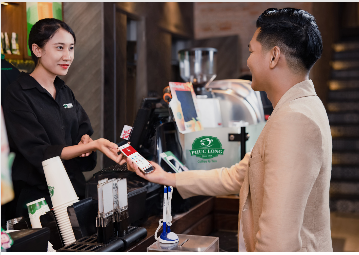
Through the introduction of the WIN AI application, which is integrated into the store's "Smart POS" system, Masan hopes to accelerate the digitization of consumers starting in 2023. Through data-driven recommendations from the WIN AI, this consumer tech enables cashiers to become more than merely payment contacts and improve the customer's shopping experience.
Through the WIN Membership platform, Masan Group also aims to surpass 1 million unbanked clients by being the doorway to mass retail banking with the integration of consumer tech. By combining WIN AI with Trusting Social's AI-based credit assessment platform, we can simultaneously meet the financial requirements of our WIN Members and digitally issue 500,000 credit cards.